

Deep ’n Blue Subotica · Education · Basic equipment
Blade, split and open-heel designs; efficient kicks and adaptation.
What is it and what is it used for?
Fins increase the surface area with which the legs push water and enable more efficient movement. Different designs affect perceived resistance, manoeuvrability, fatigue and compatibility with swimming techniques.
When working close to the bottom or in an overhead environment, kick control is more important than maximum speed.
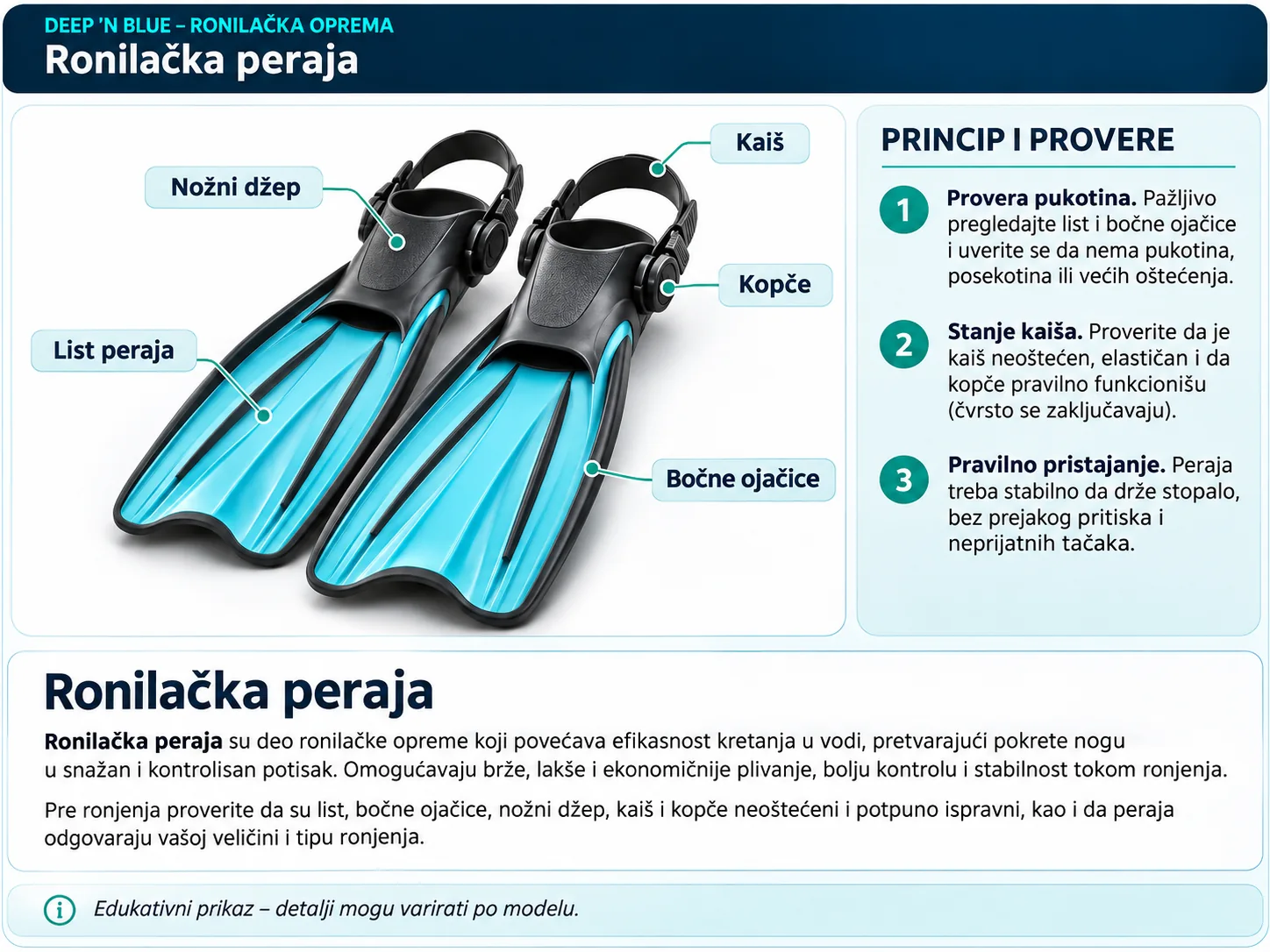
Components and basic concepts
- Fin blade – transfers thrust to the water.
- Foot pocket – holds the foot or dive boot.
- Closed heel or open-heel system – depending on the model.
- Strap or spring – secures an open-heel fin.
How does it work?
- Movement of the blade pushes water backwards.
- The resulting reaction force propels the body forward.
- Different kicks (flutter, frog, modified) provide different types of control.
Selection and proper use
- Closed-heel fins are suitable for certain conditions and footwear.
- Open-heel fins can be used with dive boots and are often easier to put on.
- Choose stiffness according to your strength, technique and overall equipment configuration.
Pre-dive check
- Inspect the blade for cracks.
- Check the straps or springs and compatibility with the dive boots.
- Try moving in full equipment in a controlled environment.
Common mistakes
- Excessively long kicks near sediment.
- Unsuitable stiffness and cramps.
- An unsecured strap that may come off.
Maintenance and storage
- Rinse and dry before storage.
- Do not leave the blade bent in an unnatural position for long periods.
- Keep spare straps accessible if your configuration requires them.
Instructor’s note: For cave and wreck diving, finning techniques are learned through practical training to control sediment disturbance and body position.
Further reading
For pre-dive checks and maintenance, see DAN – Gear Care Guidelines and DAN – Diving Equipment. The specific manufacturer’s instructions and training take precedence over this general overview.