

Deep ’n Blue Subotica · Education · Breathing and gas
Gas flow from the cylinder through the first and second stages, octopus, HP and LP ports.
What is it and what is it used for?
A regulator enables breathing from a high-pressure cylinder by reducing the pressure to suit the surroundings in two stages. The system comprises a first stage, one or more second stages, and the appropriate connections and hoses.
The configuration must suit the diver’s training, water temperature, planned dive and gas-sharing procedures.
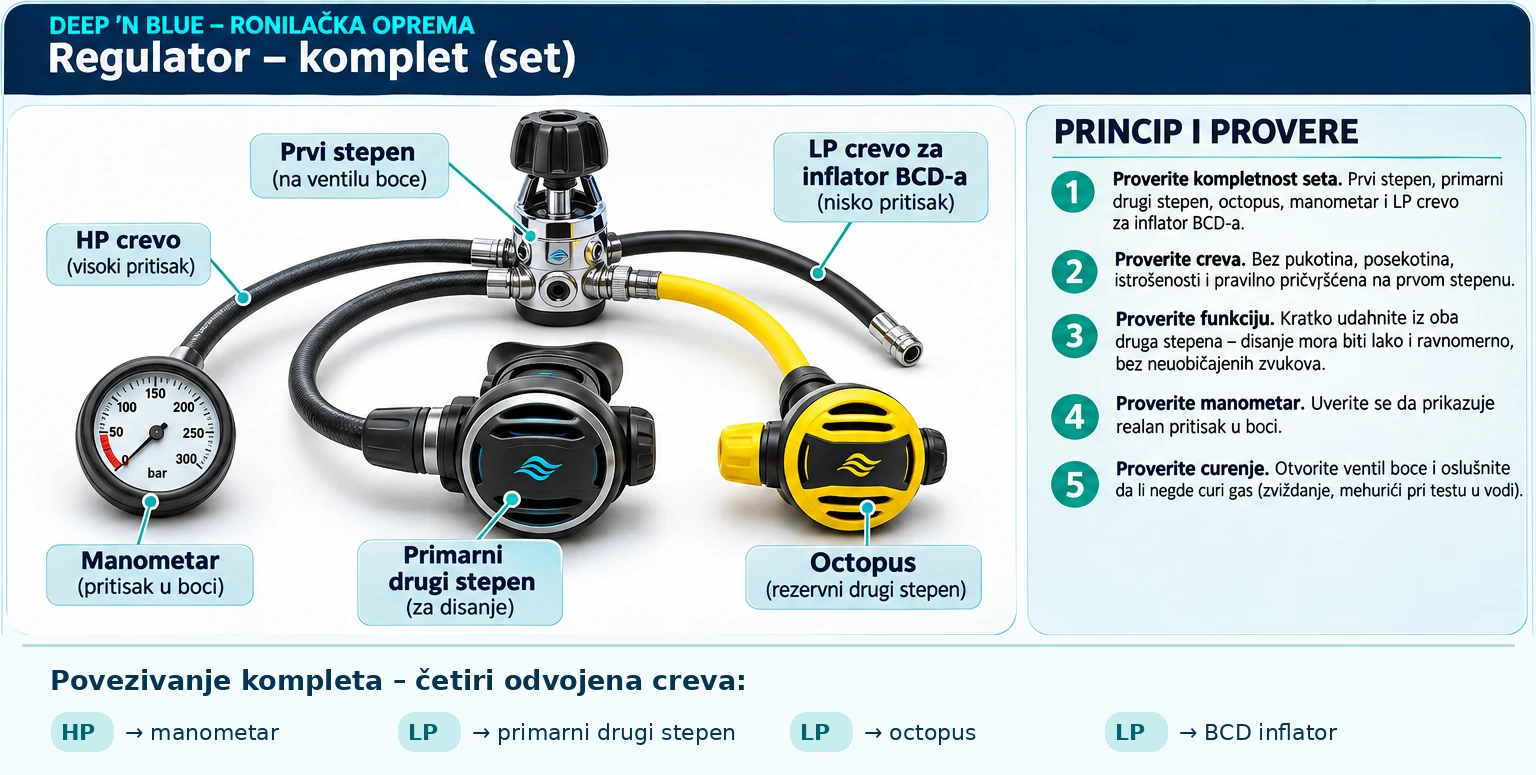
Components and basic concepts
- First stage – reduces high cylinder pressure to intermediate pressure.
- Primary second stage – delivers gas on the diver’s demand.
- Alternate second stage – backup source according to the configuration.
- LP hoses – supply gas to the second stage and inflator.
- HP port – transmits pressure to the pressure gauge or appropriate sensor.
How does it work?
- Gas from the cylinder enters the first stage through a compatible DIN/INT connection.
- The first-stage mechanism maintains intermediate pressure within its design limits.
- Through its diaphragm and valve, the second stage delivers gas on inhalation at a pressure close to ambient pressure.
Selection and proper use
- Threads, hoses, valves and working pressures must be compatible.
- In cold water, use a system rated for the relevant conditions.
- Position the backup source so that your buddy can find it according to the agreed procedure.
Pre-dive check
- Inspect mouthpieces, hoses, connections and seals.
- With the cylinder valve open, check the pressure gauge and breathe several times from both second stages.
- Check for unintended gas flow (freeflow), leaks and accessibility of all hoses.
- Perform the check as part of the standard buddy check.
Common mistakes
- Do not interchange HP and LP connections without technical specifications.
- A damaged hose or freeflow is not an acceptable condition for diving.
- Incorrect hose routing can hinder breathing and gas sharing.
Maintenance and storage
- Rinse according to the manufacturer’s manual, with the first stage suitably protected.
- Do not open or adjust the mechanism without service training.
- Service intervals and approved parts depend on the model.
Instructor’s note: Intermediate-pressure adjustment and regulator disassembly must be left to qualified service personnel.
Further reading
For pre-dive checks and maintenance, see DAN – Gear Care Guidelines and DAN – Diving Equipment. The specific manufacturer’s instructions and training take precedence over this general overview.