

Deep ’n Blue Subotica · Education · Basic equipment
Jacket, back-inflate and wing: components, buoyancy control and checks.
What is it and what is it used for?
A BCD (Buoyancy Control Device) is an adjustable air bladder that allows the diver to change their overall buoyancy. Most recreational BCDs also carry the cylinder and help arrange equipment.
Buoyancy changes with depth: the gas in the bladder occupies less volume during descent and more during ascent. Adjustments must therefore be small, timely and controlled.
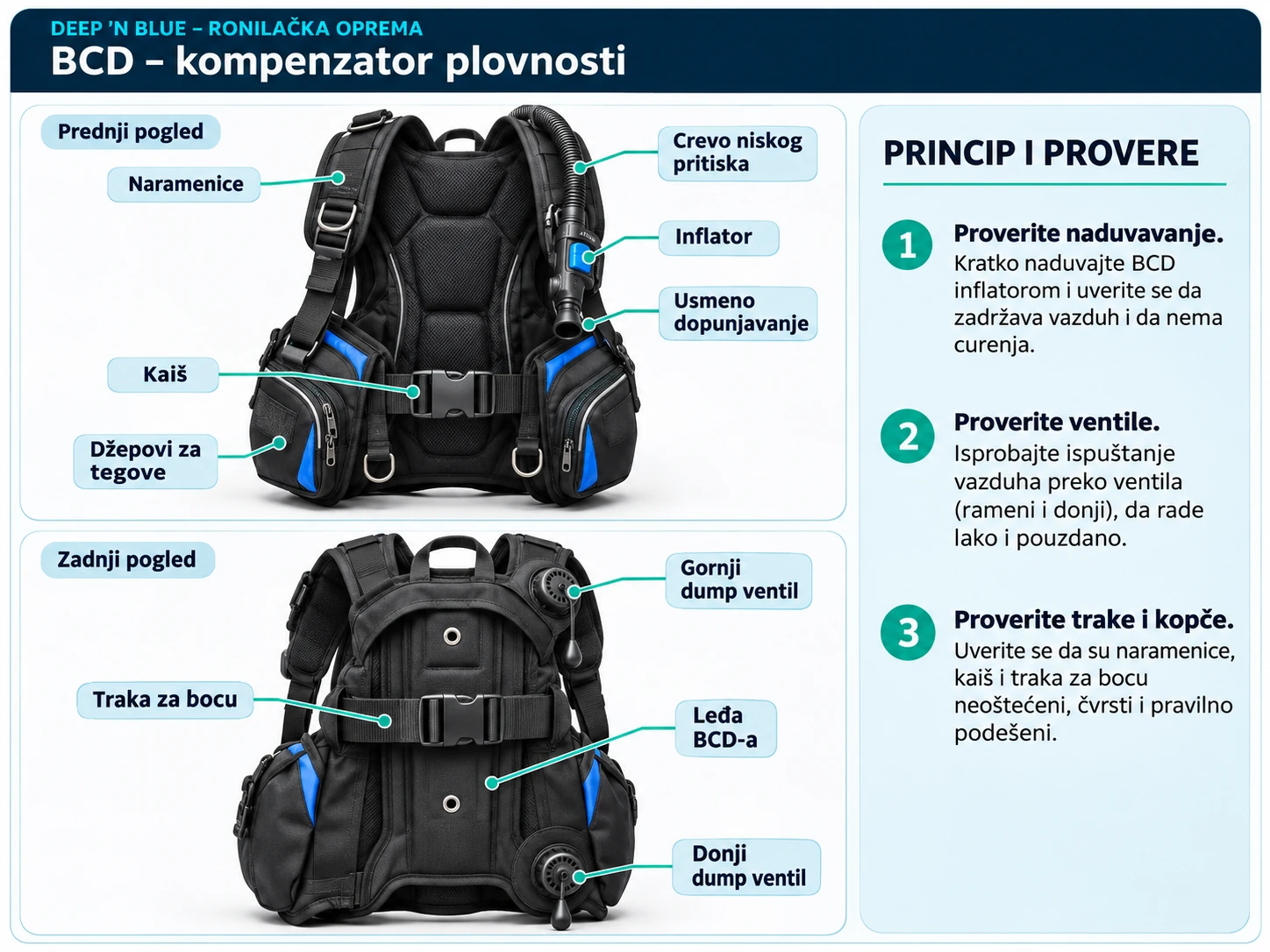
Components and basic concepts
- Air bladder – the space into which gas is added or from which it is released.
- Inflator – gas supply from the LP hose and a mouthpiece for oral inflation.
- Dump valves – allow controlled gas release in a suitable position.
- Straps and cylinder attachment system – hold the cylinder and bladder in place.
- D-rings, pockets and integrated weights – depend on the type of BCD.
How does it work?
- Pressing the inflator button allows gas to enter the bladder and increases its volume.
- Opening the appropriate valve releases gas from the bladder and reduces buoyancy.
- During ascent, gas expands; the diver must monitor the ascent rate and release gas in good time.
Selection and proper use
- A jacket surrounds the torso, a back-inflate BCD has its bladder mainly behind the back, and a wing is a separate bladder used with a backplate and harness.
- Correct weighting and a horizontal position in the water reduce unnecessary adjustments.
- Fine control is achieved through breathing technique within proper training, not by constantly pressing the inflator.
Pre-dive check
- Inflate the BCD and check that the bladder retains gas.
- Check all buttons, dump valves, straps and buckles.
- Together with your buddy, check the cylinder attachment and accessibility of the controls.
- Before entering the water, check that the LP hose fits the connector and is securely attached.
Common mistakes
- Holding the inflator button down too long can cause uncontrolled buoyancy.
- Releasing gas through a valve that is not at the highest point of the bladder is often ineffective.
- Incorrect weighting cannot safely be “fixed” by inflating or deflating the BCD.
Maintenance and storage
- After diving, rinse the outside with fresh water.
- Rinse the inside and dry it according to the manufacturer’s manual.
- Inspect valves, inflator and seams regularly; service according to the manufacturer’s instructions.
Instructor’s note: Practical training is required for procedures in the event of a stuck inflator or BCD failure. This diagram is not a service manual.
Further reading
For pre-dive checks and maintenance, see DAN – Gear Care Guidelines and DAN – Diving Equipment. The specific manufacturer’s instructions and training take precedence over this general overview.