

Deep ’n Blue Subotica · Education · Basic equipment
Lens, silicone, nose pocket, pressure equalization and selection.
What is it and what is it used for?
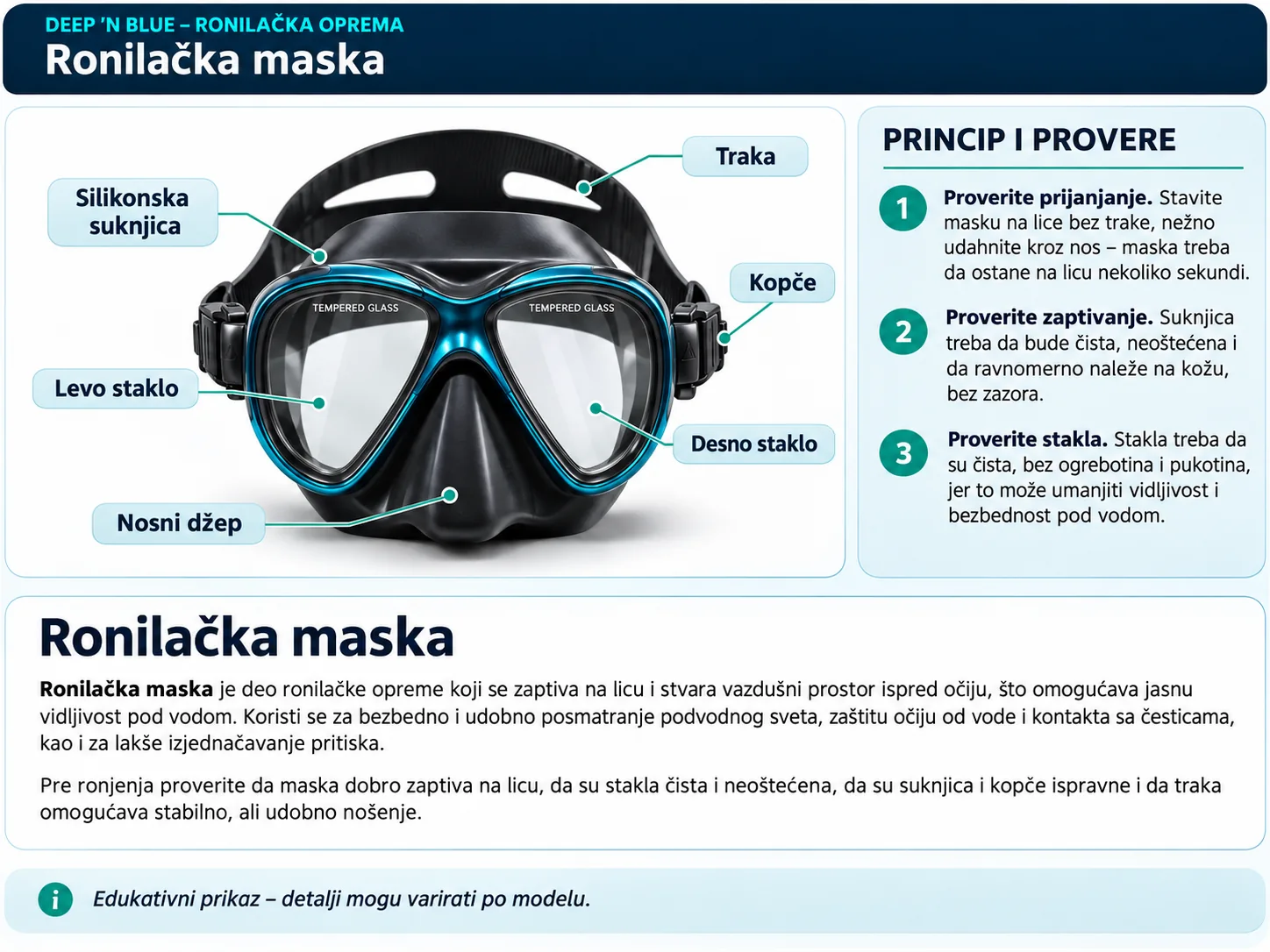
The mask creates an air space in front of the eyes, enabling clear vision underwater. Since pressure changes with depth, the pressure in this space is equalized by gently exhaling through the nose.
A good fit depends on facial anatomy, not just appearance, volume or price.
Components and basic concepts
- Tempered glass or other suitable glass designed for diving.
- Silicone skirt – fits against the face and forms a seal.
- Nose pocket – allows pressure equalization and pinching the nose.
- Frame or frameless construction.
- Strap and buckles – adjust the fit.
How does it work?
- The air space inside the mask enables clear vision.
- Gently exhaling through the nose equalizes mask pressure during descent.
- If water enters, it is cleared from the mask by exhaling through the nose while adopting the appropriate position.
Selection and proper use
- Try on the mask without overtightening the strap.
- Check compatibility with the hood and access to the nose.
- Proper transport and lens protection are important for a spare mask.
Pre-dive check
- Check the skirt, lens and buckles.
- Check that hair or the hood does not interfere with the mask seal.
- Practise mask clearing under an instructor’s supervision.
Common mistakes
- Overtightening the strap.
- Forgetting to equalize mask pressure.
- Using goggles or ordinary glass not designed for diving.
Maintenance and storage
- Rinse with fresh water, paying particular attention to removing sand from the buckles.
- Protect from direct sunlight and deformation.
- Use an anti-fog product according to the manufacturer’s instructions.
Instructor’s note: If you feel pain or pressure on your face, stop descending and equalize the mask correctly; never force it.
Further reading
For pre-dive checks and maintenance, see DAN – Gear Care Guidelines and DAN – Diving Equipment. The specific manufacturer’s instructions and training take precedence over this general overview.