

Deep ’n Blue Subotica · Education · Freediving and spearfishing
Neoprene suit adapted for extended time at the surface and freedom of movement
What is it and what is it used for?
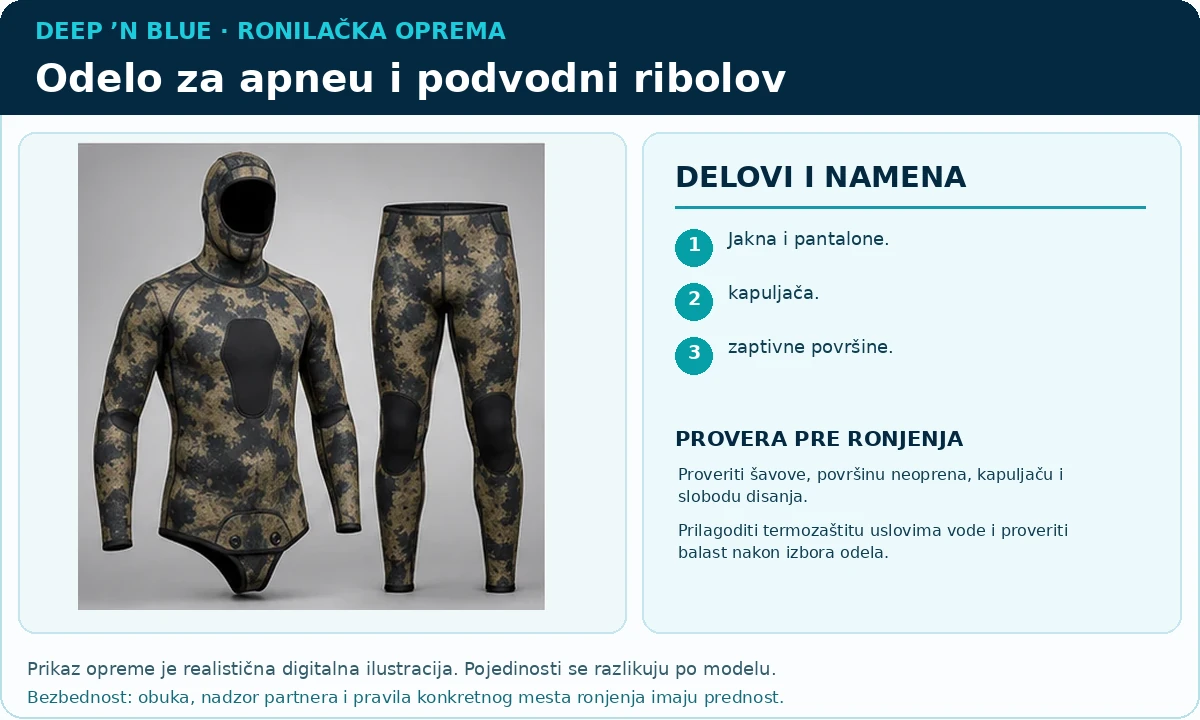
Freediving wetsuits come in different thicknesses and cuts, often in two pieces with an integrated hood. Open-cell neoprene requires careful donning and maintenance.
Freediving and spearfishing involve particular risks. Plan activities with a trained buddy, and spearfish only where it is permitted.
Components and basic concepts
- Jacket and trousers.
- Hood.
- Sealing surfaces.
- Knee and chest reinforcement where provided by the model.
How does it work?
- The retained layer of water and the insulating structure of neoprene reduce heat loss; compression at depth changes buoyancy.
Selection and proper use
- The suit must suit the water conditions, body shape and planned activity; ballast weight should be assessed separately.
- Choose equipment according to training objectives, site conditions and the manufacturer’s instructions.
Pre-dive check
- Check seams, neoprene surfaces, the hood and unrestricted breathing.
- Adapt thermal protection to water conditions and check ballast after choosing the suit.
Common mistakes
- Unsuitable equipment and excessive loading can increase risk.
- Misjudging personal limits and the absence of a buddy can lead to loss of consciousness and drowning.
Maintenance and storage
- Rinse, dry and inspect according to the manufacturer’s instructions.
- Do not use damaged equipment; store it safely, particularly sharp items.
Instructor’s note: Never practise freediving alone or with hyperventilation. Specialised equipment and spearfishing require training, supervision, checking local regulations and a responsible attitude towards nature.
Further reading
For pre-dive checks and maintenance, see DAN – Gear Care Guidelines and DAN – Diving Equipment. The specific manufacturer’s instructions and training take precedence over this general overview.