

Deep ’n Blue Subotica · Education · Instruments and navigation
Measuring remaining pressure and understanding the gas reserve.
What is it and what is it used for?
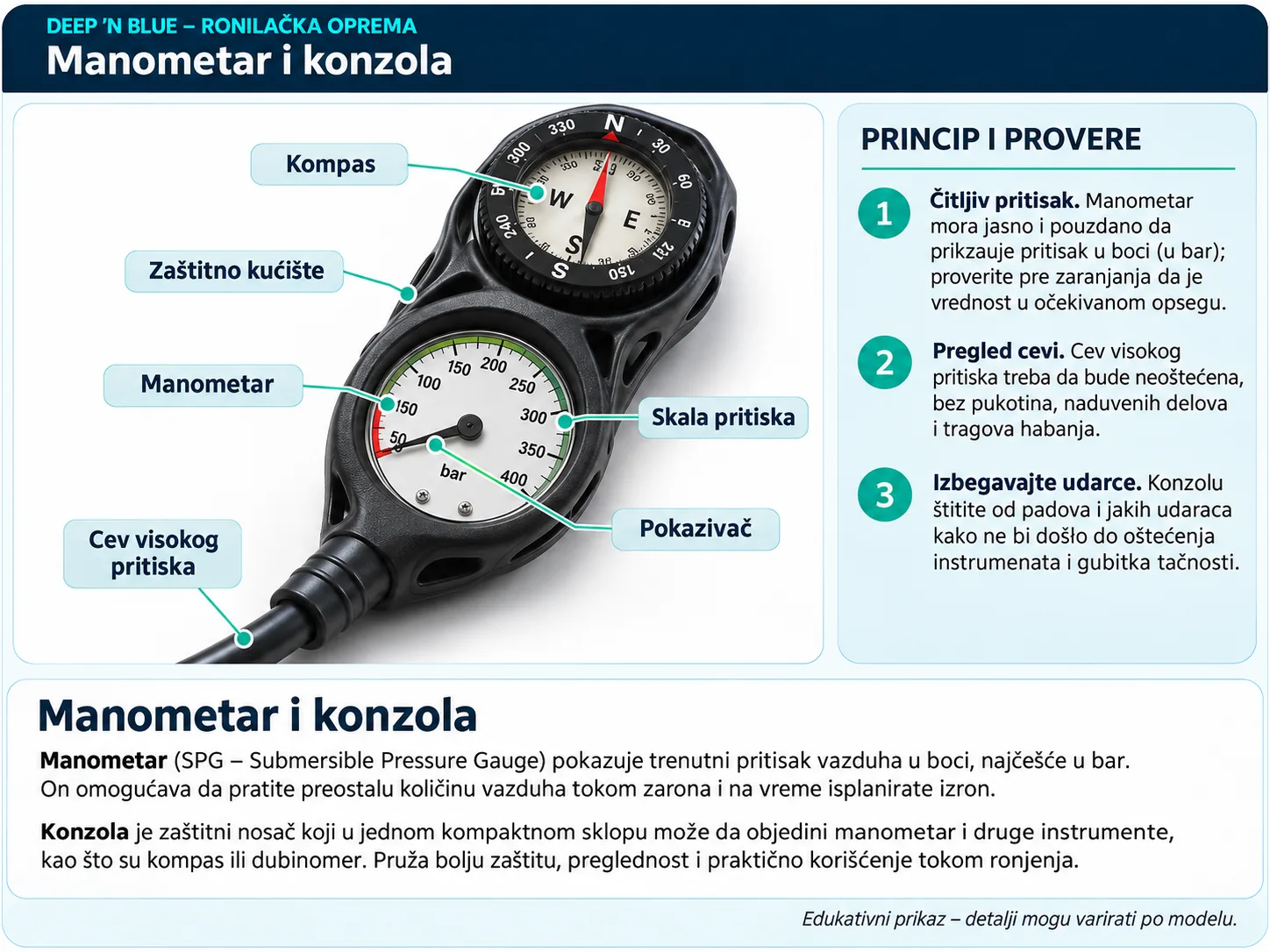
A submersible pressure gauge (SPG) displays the gas pressure in the cylinder. It does not directly indicate the remaining minutes of breathing time, because consumption depends on depth, exertion and breathing.
In wireless systems, a suitable transmitter can send pressure data to the dive computer; the planning principle remains the same.
Components and basic concepts
- Pressure scale and needle or digital display.
- Housing and impact protection.
- HP hose or a suitable wireless transmitter.
- Connection to the first-stage HP port.
How does it work?
- Pressure from the HP port acts on the measuring mechanism.
- The needle or sensor provides the pressure reading.
- The diver compares the reading with the gas consumption plan and the predetermined reserve.
Selection and proper use
- Before diving, determine the turn pressure and reserve according to the plan, not habit.
- The SPG should be positioned for easy reading and secured.
- Monitor pressure during the dive, especially before changing depth or returning.
Pre-dive check
- Read the gauge with the cylinder valve open before setting off.
- Inspect the glass, needle, hose and connections.
- Check for unusual delays in readings or leaks.
Common mistakes
- Checking pressure too late.
- Treating pressure as equivalent to remaining breathing time.
- Allowing the gauge to drag along the bottom and become damaged.
Maintenance and storage
- After diving, rinse and inspect the connections.
- A damaged HP system must be inspected by a service technician.
- Do not use a device with cracks or illegible scales.
Instructor’s note: The reserve gas rule depends on the profile, team and environment; simply using “50 bar” is not a universal plan for every dive.
Further reading
For pre-dive checks and maintenance, see DAN – Gear Care Guidelines and DAN – Diving Equipment. The specific manufacturer’s instructions and training take precedence over this general overview.