

Deep ’n Blue Subotica · Education · Freediving and spearfishing
Long separate fins (bi-fins) for efficient movement
What is it and what is it used for?
Freediving fins have a long, flexible blade that converts leg movement into thrust. They may be made of polymers, fibreglass or carbon fibre.
Freediving and spearfishing involve particular risks. Plan activities with a trained buddy, and spearfish only where it is permitted.
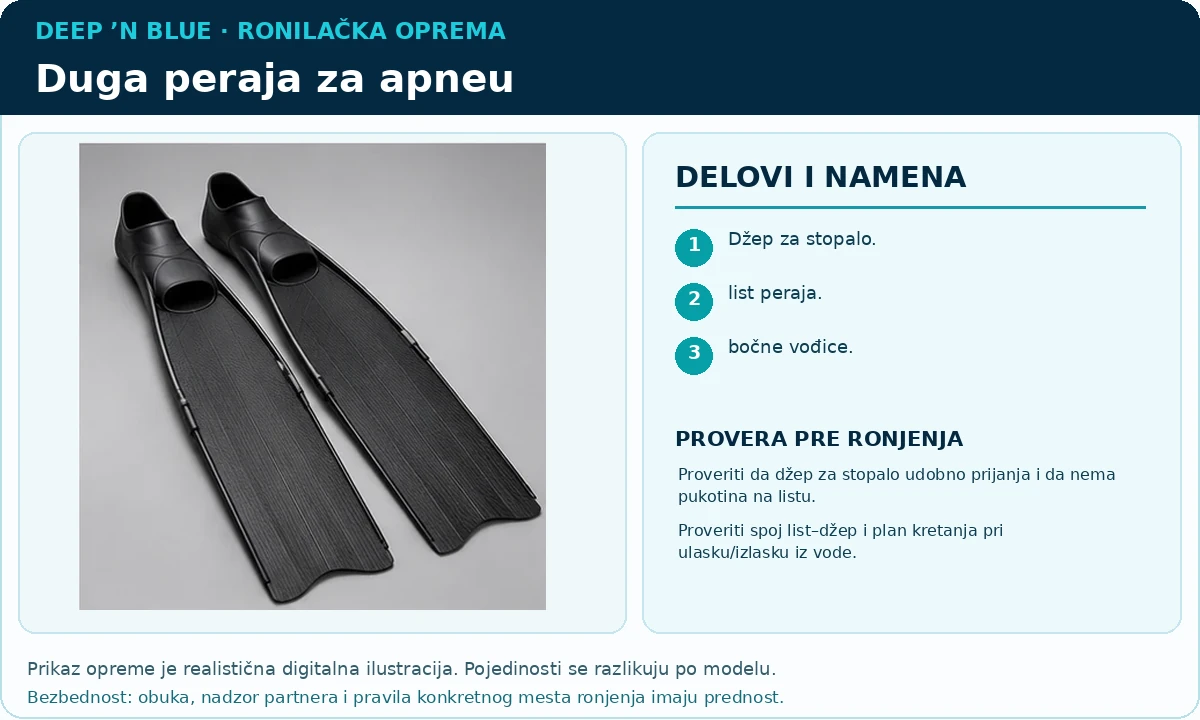
Components and basic concepts
- Foot pocket.
- Fin blade.
- Side rails.
- Blade-to-foot-pocket connection.
How does it work?
- The flexible blade bends and springs back during a proper kick; a stiff blade is not automatically better.
Selection and proper use
- Appropriate size and flexibility allow controlled movement without fatigue. Check foot fit and terrain, especially when entering from shore.
- Choose equipment according to training objectives, site conditions and the manufacturer’s instructions.
Pre-dive check
- Check that the foot pocket fits comfortably and that the blade has no cracks.
- Check the blade-to-foot-pocket connection and plan movement when entering and leaving the water.
Common mistakes
- Unsuitable equipment and excessive loading can increase risk.
- Misjudging personal limits and the absence of a buddy can lead to loss of consciousness and drowning.
Maintenance and storage
- Rinse, dry and inspect according to the manufacturer’s instructions.
- Do not use damaged equipment; store it safely, particularly sharp items.
Instructor’s note: Never practise freediving alone or with hyperventilation. Specialised equipment and spearfishing require training, supervision, checking local regulations and a responsible attitude towards nature.
Further reading
For pre-dive checks and maintenance, see DAN – Gear Care Guidelines and DAN – Diving Equipment. The specific manufacturer’s instructions and training take precedence over this general overview.